What do website and UI/UX designers charge on Unjumble?
The middle half of web and UI/UX designers on Unjumble who list a rate set $70 to $150 an hour, with a midpoint of $110, from 36 rates. Those are their own figures, before the fee comes out. Of the 71 who state their experience, 30 have 10 years or more. Quote a fixed price in stages for a site or a set of screens with a clear scope. Keep hourly or a retainer for ongoing design work, like new pages, testing changes or design support for a developer.
How do I quote a website or UI/UX design gig?
Price the stages the owner can see: research, sitemap and wireframes, visual design, then the build or a developer handover. Quote by templates and key flows rather than page count, because a 12-page site might need only 4 templates, while one booking flow can take as long as the homepage. At the $110 midpoint, a design-only small business site of 25 to 45 hours is $2,750 to $4,950 before the fee. Say how many rounds of changes each stage includes, and whether the build is yours or a developer's.
What kinds of website and UI/UX gigs do businesses post?
Mostly websites that have to bring something in: enquiries, bookings, quotes or sales. Expect design-led small business sites, redesigns of key pages, sign-up or checkout flows where people drop out, and screens for an app or customer portal a developer will build. Some briefs want Figma files for their own developer, others want design and build together. Designers in this area on Unjumble most often also list Web Design, Web Development and Logo & Brand Identity, so say on your profile if you build or brand as well.
What wins a UI/UX design bid?
Showing the thinking before the pixels. Name the one action their site needs visitors to take, point to where the current site gets in the way (a booking button you can't see on a phone, a form with 12 fields), and say how you'd learn more, such as their analytics or a few short calls with customers. Keep the jargon out: 'a clickable mock-up you can try on your phone' lands better than 'a high-fidelity prototype'. Link one case study that walks from sitemap to finished screens.
What should a UI/UX portfolio show?
Case studies that show the steps, not just the final screens. For each one, give the problem in a line, then the sitemap or user flow, the wireframes, the finished design on phone and desktop, and what changed afterwards, such as more enquiries or bookings or fewer drop-outs, if the client is happy to share. 2 or 3 of these beat a gallery of 20 polished screens. If the work was for an agency or under an NDA, ask before you share it, or remove the names and describe your part.
What handover files do businesses and developers expect?
A design file a developer can build from without guessing, usually in Figma. That means named, organised pages, components with their states (hover, error, empty, loading), colour and type styles, phone and desktop layouts, and a clickable prototype of the key flows. Check colour contrast and text sizes against WCAG 2.2 AA, the level the Australian Human Rights Commission points organisations to. Make sure the business owns the file: Figma has a free plan, so set it up in their account or move it there at handover.
Who owns the designs, and what admin should I have sorted?
You own the designs you create unless your agreement transfers them: in Australia, IP a contractor creates stays with the contractor unless the contract says otherwise. Say in your bid what moves to the business on final payment, usually the final files, and what you keep, such as your own UI kit, plus whether you can show the work in your portfolio. Fonts, icons and stock images keep their own licences, so buy them on the business's account. You'll need an ABN connected to complete a gig on Unjumble, and you must register for GST once your GST turnover reaches $75,000. Check your situation with your accountant.
What fees come out of a UI/UX design gig, and when do I get paid?
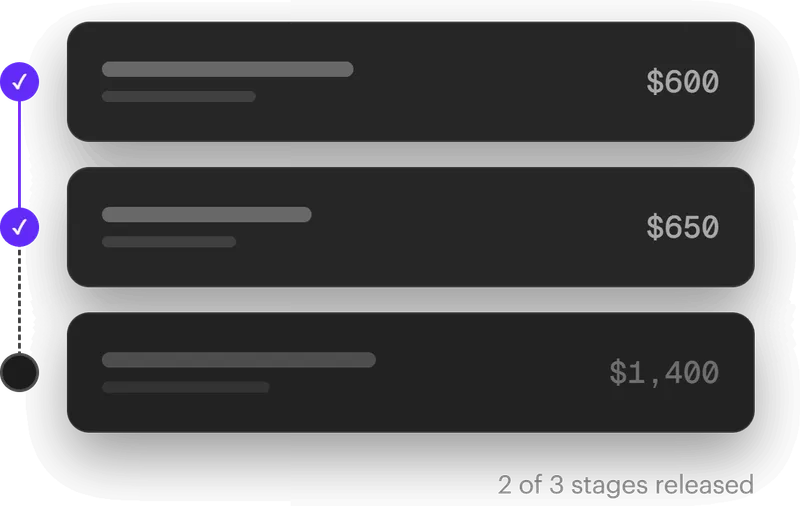
A 20% connection fee comes out of each stage until you've completed a gig with that business, then a 10% repeat fee on later gigs with them, so build it into your price. Each stage pays out when the business signs it off, or on its own 14 days after you submit it unless they raise an issue. Stage a design gig so you're paid as you go: research and wireframes first, then the visual design, then the prototype and handover files, so the design is paid for before any build starts. More on
how fees work.